Electric scooters and family trips: what the last mile really costs
The gap between the car park and the beach, the campsite and the bakery, the station and the flat: on most family holidays, the last mile is where the time and the patience disappear. An electric scooter solves part of that problem — and creates a few of its own.
Transparence
Certains liens peuvent etre affilies. Ils financent le site sans modifier notre facon de choisir, comparer ou recommander. Quand un lien commercial est present dans un guide, il est signale comme lien partenaire et replace dans un contexte editorial explicite: budget, age des enfants, saison et niveau de confort attendu. Lire notre politique complete.
On paper, a family holiday is made of long distances: the drive down, the flight, the transfer. In practice, the part that wears everyone out is much shorter. It is the eight hundred metres between the car park and the beach entrance. The kilometre and a half from the campsite pitch to the bakery. The twenty minutes from the station to the flat, with a suitcase that has already lost a wheel.
That is the last mile, and it repeats several times a day. Which is exactly why an electric scooter turns up in the conversation — usually from the parent who has done that bakery run four mornings in a row.
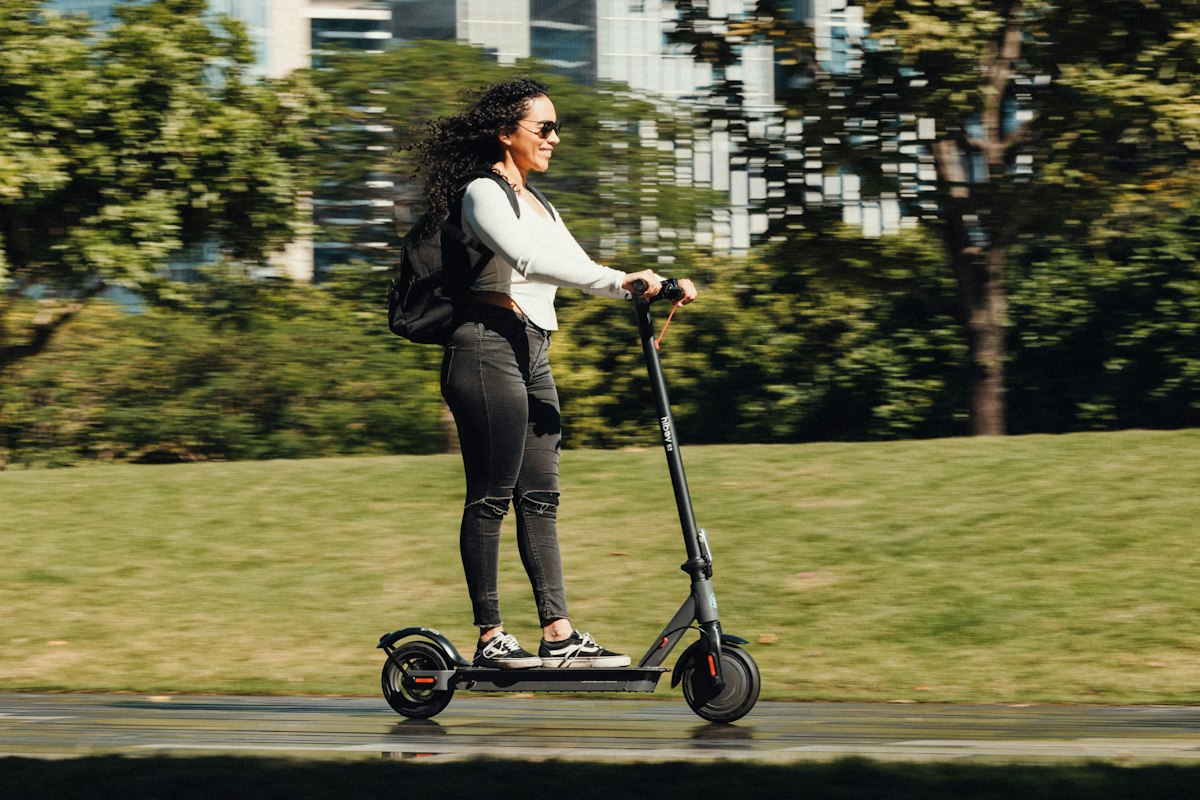
It is worth being honest about what it solves. An electric scooter does not make a family mobile. It makes one adult mobile, quickly, on a route that would otherwise eat thirty minutes. That is a narrower promise than the marketing suggests, but on some holidays it is a genuinely useful one.
Where it actually earns its place
Three situations come up again and again, and they have something in common: an adult repeatedly covering the same short distance alone.
- The campsite or holiday village run. Large sites are designed around a car you have deliberately parked for the week. The bread, the forgotten charger, the pharmacy — each becomes a twenty-five-minute round trip on foot. On a scooter it is five, which changes whether you bother at all.
- The station-to-flat transfer. For a car-free weekend, the gap between arriving and actually arriving is the weak point. One adult can scoot ahead with the keys and a light bag while the rest follow at walking pace.
- The satellite car park. Coastal towns in August push you two kilometres out. That walk, twice a day, with beach kit, is the reason families give up and drive in circles looking for a closer space.
Notice what is not on that list: moving the whole family. A scooter carries one person. If your problem is transporting three children and a cool box, this is not the answer — a bike with a trailer is.
The honest test before buying
- Will an adult repeat the same short trip, alone, several times during the stay?
- Is there a paved, low-traffic route for it — cycle path, promenade, quiet lane?
- Do you have a way to carry and charge it where you are staying?
- If any answer is no, hiring on site for two days will tell you more than a purchase.
Range and weight: the two numbers that decide everything
Every spec sheet leads with range. It is the number most likely to disappoint, because the advertised figure comes from a light rider on flat ground at a steady moderate speed — conditions that describe almost nobody.
A realistic planning assumption is roughly sixty per cent of the advertised range, and less again if you are carrying a rucksack, riding into wind, or climbing anything. A model rated for 40 km is a comfortable 25 km model in real life. For a last-mile use case that is still ample: four daily round trips of two kilometres is eight kilometres a day. Range is rarely the real constraint.
Weight almost always is, and it gets far less attention. The moment the scooter stops rolling, you are carrying it — up to the flat, into the boot, onto a train, down to the beach hut. There is a meaningful difference between a 13 kg model and a 25 kg one, and you will discover it on a staircase.
The trade-off is direct: bigger battery and suspension mean more weight. For family holiday use, the sensible bias is towards the lighter end, because the trips are short and the carrying is frequent.
The rules nobody reads until it is too late
Regulations vary by country and are enforced unevenly, but a few points are consistent enough across Europe to plan around.
- Age. Most European countries set a minimum age for riding an electric scooter on public roads — commonly 12 or 14, and in France it is 14. This is the rule that most often surprises families who assumed the children would take turns. In practice, the scooter stays with the adults.
- One rider. Carrying a passenger is prohibited essentially everywhere. A child on the deck with a parent is not a grey area; it is the single most reliably penalised behaviour.
- Where you may ride. Cycle paths where they exist, otherwise the road; pavements are generally forbidden. Seafront promenades are frequently the exception and post their own signs — read them, because coastal towns do enforce this in summer.
- Speed. Capped at 25 km/h in most of the EU, often lower in designated zones.
Two more practical points. Air travel is effectively closed: lithium batteries above 160 Wh are barred from passenger aircraft, and nearly every electric scooter exceeds that comfortably. This is a car or train accessory, not a flying one. And rail operators each set their own rules on folded scooters — usually allowed as luggage, occasionally not, so it is worth ten seconds on the operator's site before travelling.
Mon astuce famille
Check the battery's watt-hour rating before you plan anything involving a plane. It is printed on the deck or the battery housing. Above 160 Wh — which covers almost every adult scooter — it cannot travel in the hold or the cabin, on any airline, at any price.
What it does not replace
It is worth naming the limits plainly, because a scooter bought on the strength of a holiday fantasy usually ends up in the garage by October.
It does not replace a car for a family of four. It does not work on sand, gravel campsite tracks, or cobbled old towns — small wheels are unforgiving, and the ride quality on anything other than tarmac ranges from unpleasant to unsafe. It does not carry shopping beyond what fits in a rucksack. And in the rain, braking distances on a scooter deteriorate faster than most people expect.
There is also a straightforward budget question. A scooter is a purchase that only makes sense if it is used outside the holiday too — the commute, the school run, the station. Bought purely for two weeks in August, hire almost always wins on cost.
The short version
An electric scooter is a last-mile tool for one adult, and it is very good at that one job. On a large campsite, a car-free weekend, or a stay built around a distant car park, it removes a repeated daily friction that nobody plans for but everybody feels by day three.
It is not family transport, it is not for the children, and it does not fly. Judge it on how many times someone in your family will make the same short trip alone — and if the answer is "most mornings", it earns its place in the boot.
For the rest of the logistics, our notes on packing light for a family stay and on choosing accommodation by real distance to the beach cover the ground around this one.
Signature editoriale
Clara Martin
Journaliste voyage et mere de deux enfants
Chaque article est ecrit avec la meme ligne: verifier le rythme, le budget, la logistique et la vraie compatibilite avec la vie de famille avant de parler de promotion. Lire la charte editoriale